
How to Check Criminal History in Citrus County
No single search contains every Citrus County criminal record. Begin with SCORSS when the goal is a filed felony, misdemeanor, or criminal-traffic case. Use the Citrus County Sheriff's Office for a recent arrest or the incident narrative. Use the Florida Department of Law Enforcement, or FDLE, when the question extends to releasable events elsewhere in Florida. A full name, likely spelling variants, an approximate event date, and a case or report number can separate the right record from a namesake.
The fastest route is not always the most complete. SCORSS gives anonymous users an index and docket but not document images. A sheriff booking entry reflects intake allegations, not the prosecutor's final charge. FDLE's public search is name based rather than fingerprint confirmed. Compare the arrest source, the Clerk's count-by-count disposition, and the state history before treating the entries as one finished story.
When the web view stops short, use a Clerk counter for court images, a focused chapter 119 request for sheriff material, or FDLE Personal Review for your own state record.
- Choose SCORSS for a case, CCSO for a sheriff report or booking, or FDLE for statewide history.
- Search with the full name and narrow dates, case type, or other lawful identifiers.
- Match the agency, event date, charge, and case number instead of relying on the name alone.
- Open the court docket to see whether charges changed and how each count ended.
- Request the source report, counter image, certified disposition, or personal review when the online result is not enough.
Three Citrus County Record Systems
Citrus County criminal history moves through three main records. CCSO creates the arrest or incident report and the Lecanto detention operation creates the booking entry. The State Attorney then decides what to file, and the Citrus County Clerk keeps that case in SCORSS. FDLE receives arrest fingerprints and later disposition data for the statewide repository. The records are linked, but their timing and terms differ.
| Source | Best question | Main limit |
|---|---|---|
| CCSO and detention | Was an arrest or booking made? | An allegation is not a conviction. |
| Citrus Clerk and SCORSS | What charge was filed and how did it end? | Anonymous users cannot see document images. |
| FDLE CJIS | What releasable Florida history is tied to the identity? | Public name searches are not fingerprint matches. |
The Clerk's public-record request page shows the county filing route in practice.
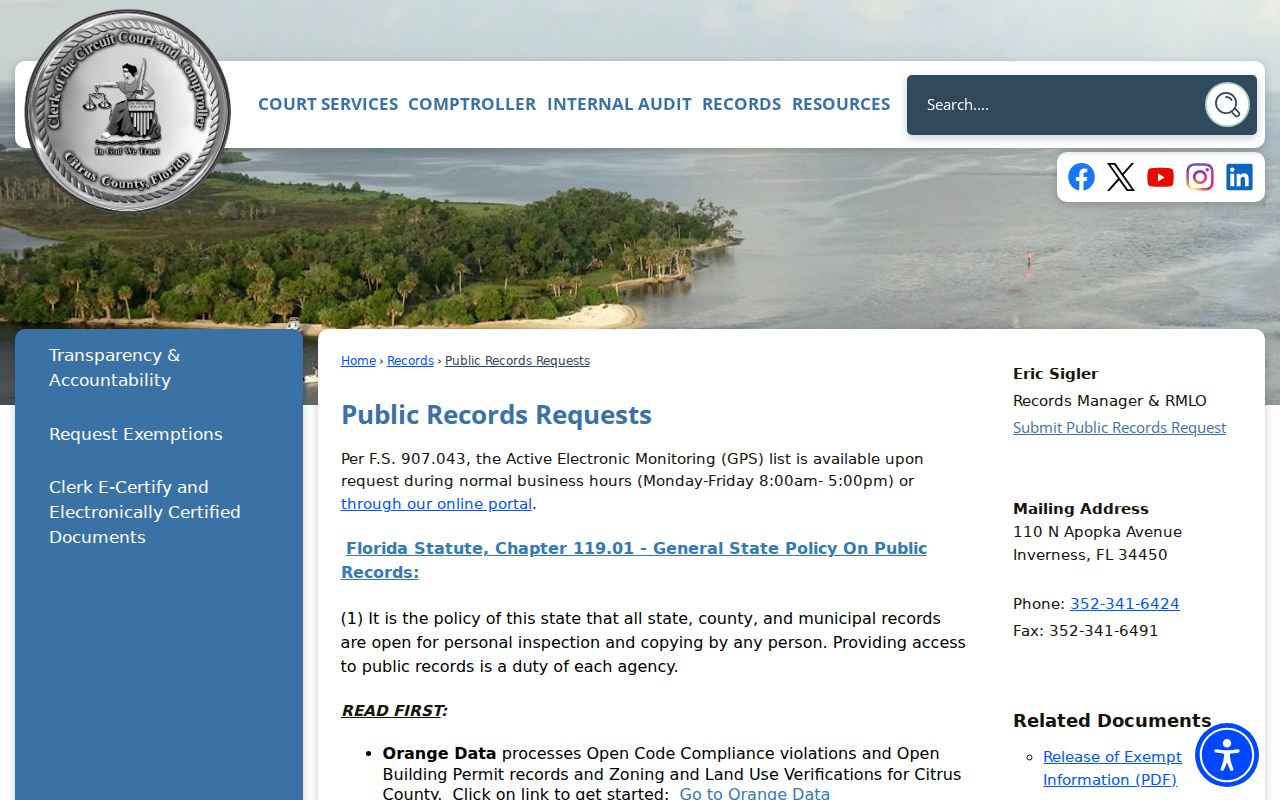
That route is for Clerk-held material. Police and arrest reports must still go to CCSO.
Official Florida Background Checks
The Florida Department of Law Enforcement Division of Criminal Justice Information Services is the central repository. Any member of the public may use the Florida Criminal History Information Internet Search for a paid name search. It returns legally releasable Florida arrest and prosecution history. It is not nationwide, and a candidate match is not fingerprint proof of identity.
For review of one's own Florida record, FDLE offers a no-fee fingerprint-based Personal Review. Fingerprints must be taken by a law-enforcement or criminal-justice agency. Statutory checks use a registered Livescan provider and an ORI supplied by the requesting agency. FDLE cannot invent or provide the ORI. The official Florida check options distinguish instant, mailed, certified, and ORI routes.
| Product | Fee | Identity method | Delivery |
|---|---|---|---|
| FDLE Instant Search | $24 plus $1 card fee | Name and demographics | Immediate, non-certified |
| FDLE staff search | $24 | Name and demographics | Mail, certified or non-certified |
| FDLE Personal Review | No FDLE fee | Fingerprints | Mail to the subject or designated attorney |
| FBI Identity History Summary | $18 FBI fee | Fingerprints | Electronic or mail |
The FDLE comparison page illustrates these official choices.
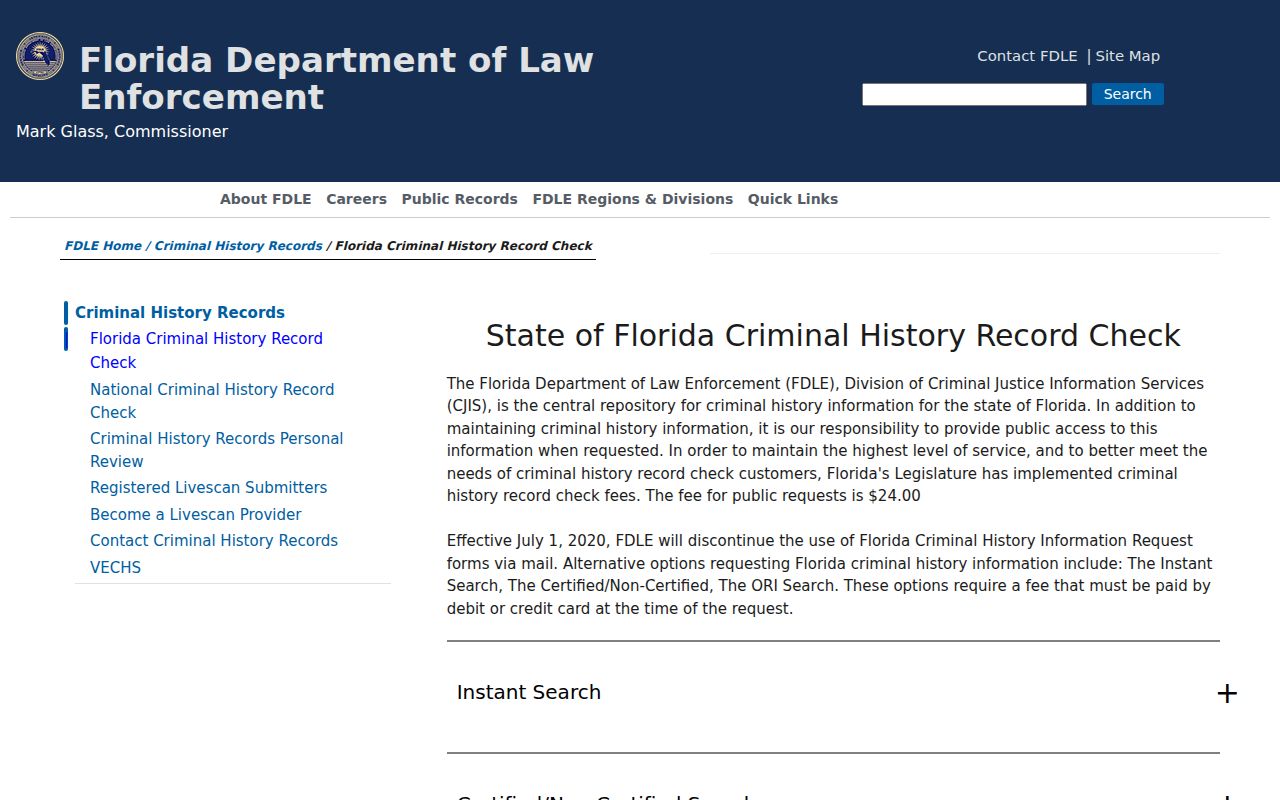
The product chosen should match the need for speed, certification, and identity certainty.
Searching Florida Records from Citrus County
FDLE Instant Search asks for both first and last name. Middle name, date of birth, race, and sex can narrow a common-name result. A Social Security number may appear as an optional field on the secure state portal; it should never be sent through an ordinary records email. Payment is due even if no record is returned, so review spellings before submitting.
| Field | Required | Use |
|---|---|---|
| Last and first name | Yes | Core identity inputs |
| Middle name | No | Separates similar names |
| Date of birth | Strongly recommended | Best common-name check |
| Race and sex | No | Demographic narrowing |
The official FDLE search screen is the correct payment and identity channel.
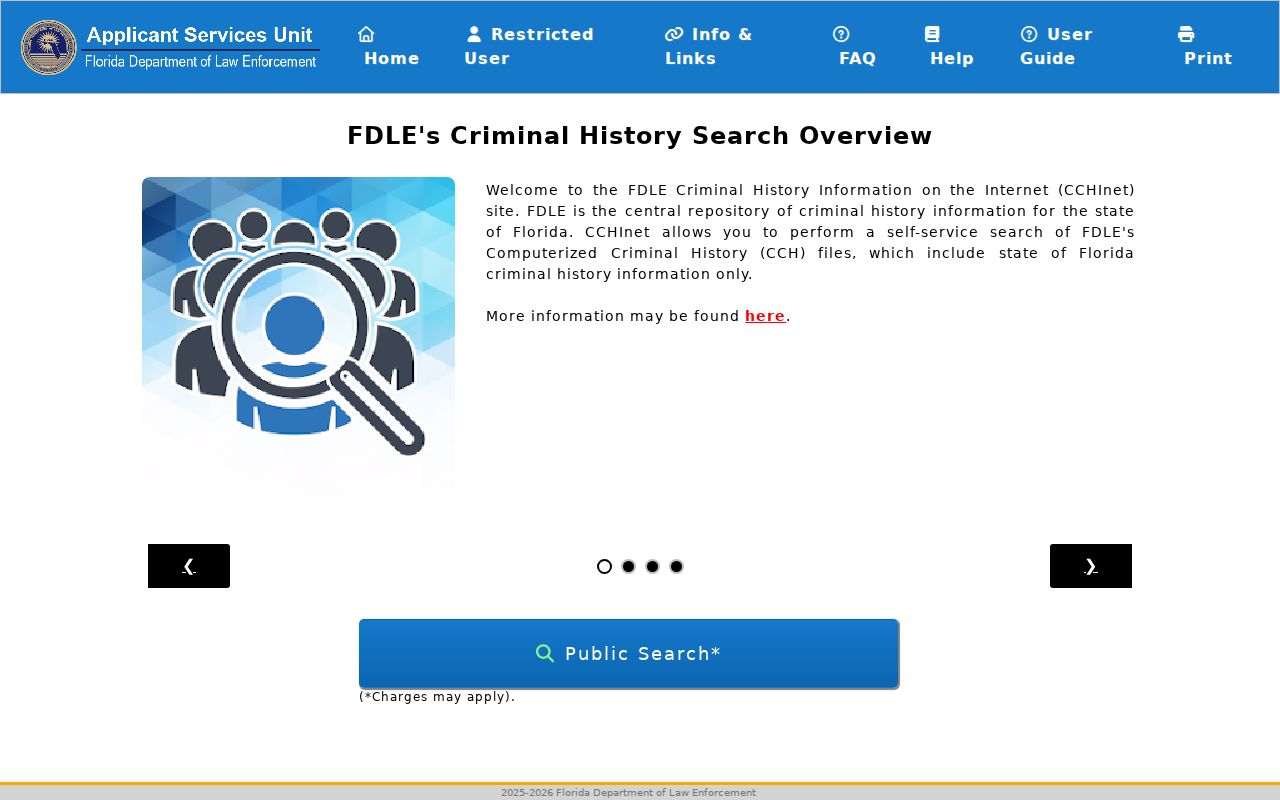
A printed instant result is useful for reference, but it is not a certified record.
Types of Criminal Records
Citrus County criminal records are defined by their custodian. CCSO keeps incident and arrest reports. The detention facility keeps booking and custody details. The Clerk holds charging papers, dockets, orders, judgments, and sentences. FDLE compiles statewide arrest cycles and reported outcomes. FDC holds state prison and much adult felony supervision data. The FDLE registry is a separate public-safety system, not a general criminal history search.
- Arrest and booking records: show the event, intake charge, bond, and custody status.
- Criminal court files: show filed counts, hearings, motions, disposition, and sentence.
- FDLE history: compiles releasable Florida events reported to the repository.
- Warrant records: identify a wanted entry that must be confirmed with the issuing agency.
- Custody and supervision records: separate county jail, FDC, federal, probation, and limited parole information.
Citrus County Record Custodians
Requests often fail because the buildings serve different parts of the system. Modern court business is at the Citrus County Courthouse in Inverness. CCSO headquarters is nearby but holds law-enforcement records, not filed pleadings. The detention facility is in Lecanto. West Citrus Government Center provides Clerk searches and copy service in Crystal River. The former Montgomery Avenue Clerk Annex counter closed on January 5, 2026, so older directions may be stale.
Citrus County Clerk
110 N. Apopka Ave.
Inverness, FL 34450
352-341-6424, option 4
Weekdays, 8 a.m.-5 p.m.
CCSO Headquarters
1 Dr. Martin Luther King Jr. Ave.
Inverness, FL 34450
352-726-1121
Ask for Records/Public Records
Detention Facility
2604 W. Woodland Ridge Dr.
Lecanto, FL 34461
352-527-3332
Custody and inmate contact
West Citrus Counter
1540 N. Meadowcrest Blvd.
Crystal River, FL 34429
352-341-6424
Weekdays, 8 a.m.-5 p.m.
The Fifth Judicial Circuit's Citrus County page shows the current courthouse and court services.
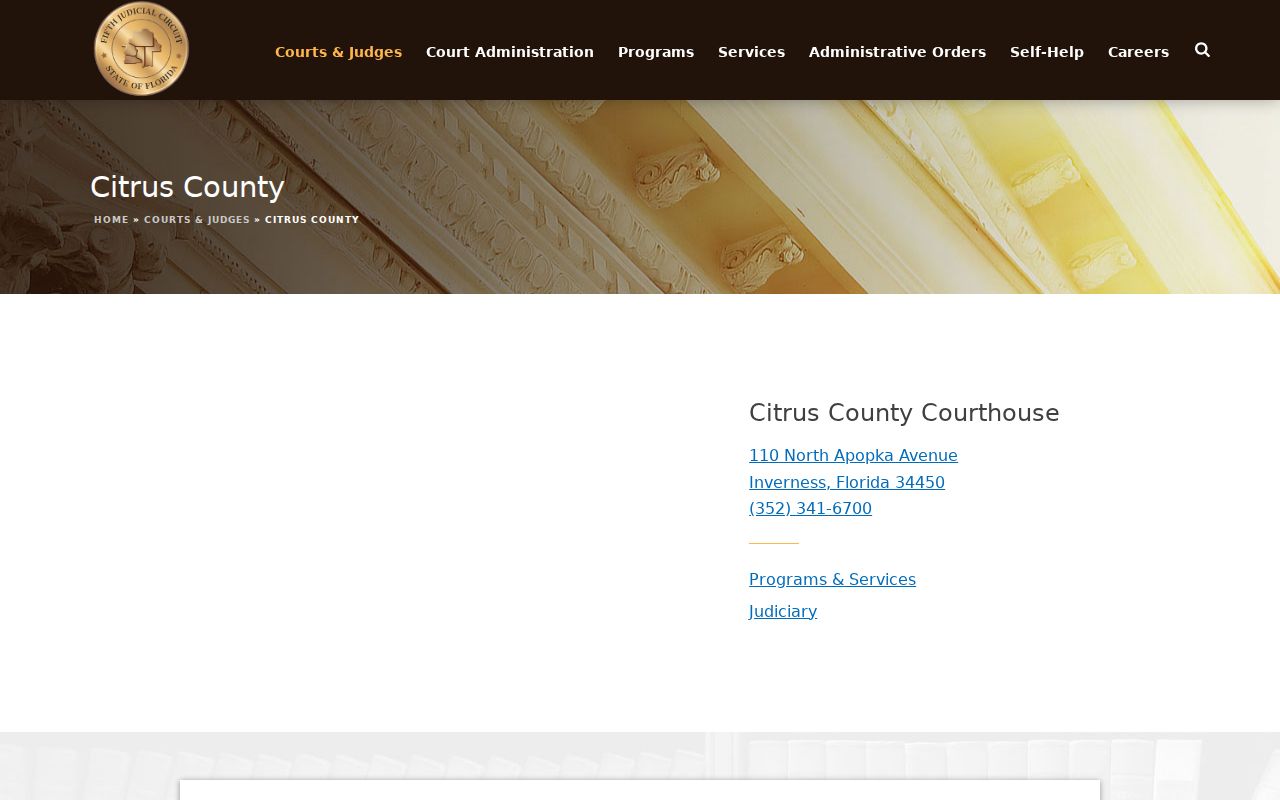
The modern Apopka Avenue courthouse, not the historic courthouse museum, is the working criminal court location.
What a Citrus County Criminal Record Shows
A Citrus County criminal record can combine identity fields with arrest cycles, filed charges, and final outcomes. The source controls the detail. Booking data adds intake time, agency, initial bond, and release status. A court docket adds the judge or division, attorneys, event dates, financial entries, and a disposition for each count. FDLE arranges reported events into a statewide chronology. Missing disposition data should be checked against the Clerk's judgment and corrected through FDLE's personal-review process when needed.
| Name & Identifiers | Legal name, aliases, birth details, and state or federal identifiers where releasable. |
|---|---|
| Arrest / Booking Data | Event date, arresting agency, transaction, intake charge, bond, and release status. |
| Charges & Statutes | Alleged or filed offense, count, degree, and Florida statute citation. |
| Disposition | Dismissal, nolle prosequi, acquittal, withhold, or adjudication for each count. |
| Sentence | Custody, probation, fines, costs, restitution, and court conditions. |
| Custody / Supervision Status | County jail, FDC custody, release, community control, probation, or other reported status. |
Citrus County Custody Searches Differ
A Citrus County jail search, the FDC Offender Search, and the federal Bureau of Prisons locator do not overlap. The Lecanto facility covers county pretrial custody and local sentences. FDC covers state prison terms and many active supervision records. Federal custody uses a separate system. A person may leave the current jail list while the court case and state record remain public.
Use the FDC Offender Search for Florida prison or qualifying supervision information.
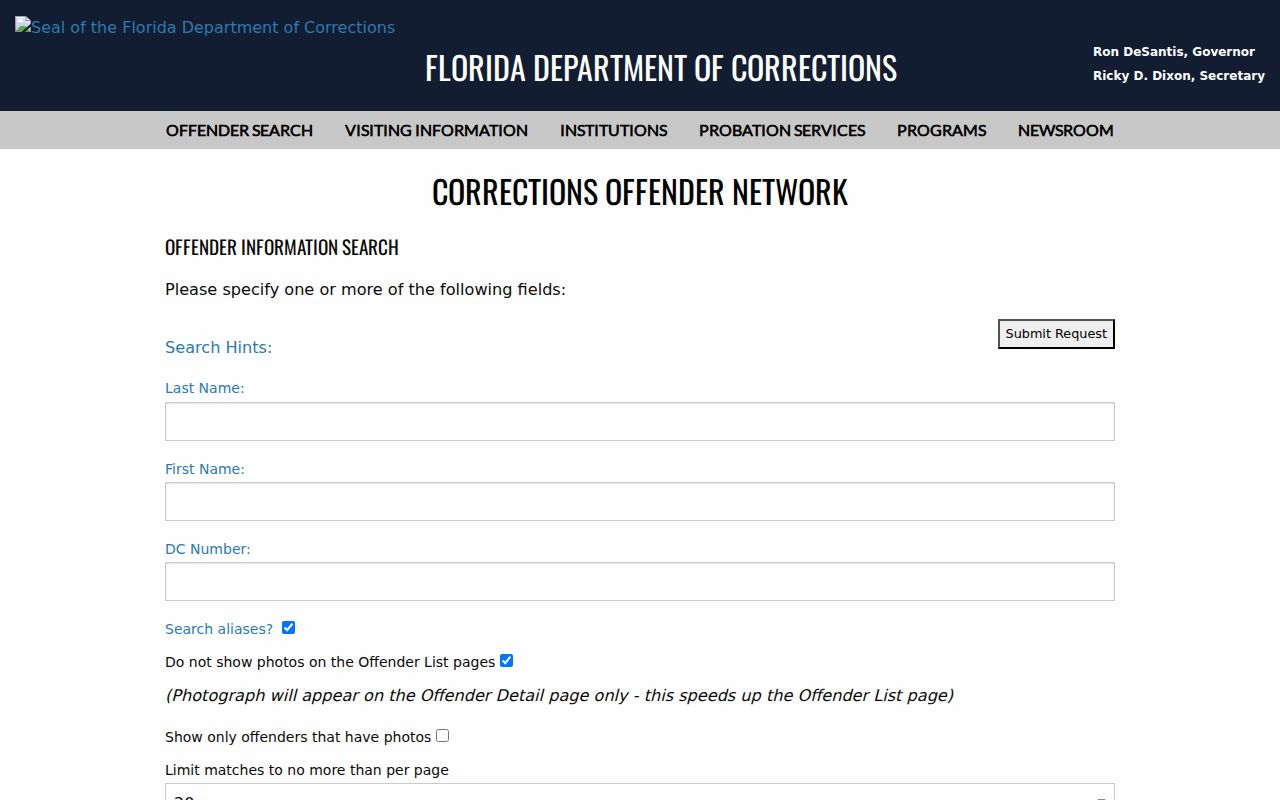
The locator should be read with the Citrus County docket because supervision terms and violation filings originate in the court case.
The FDC Community Corrections overview explains adult felony supervision and office routing.
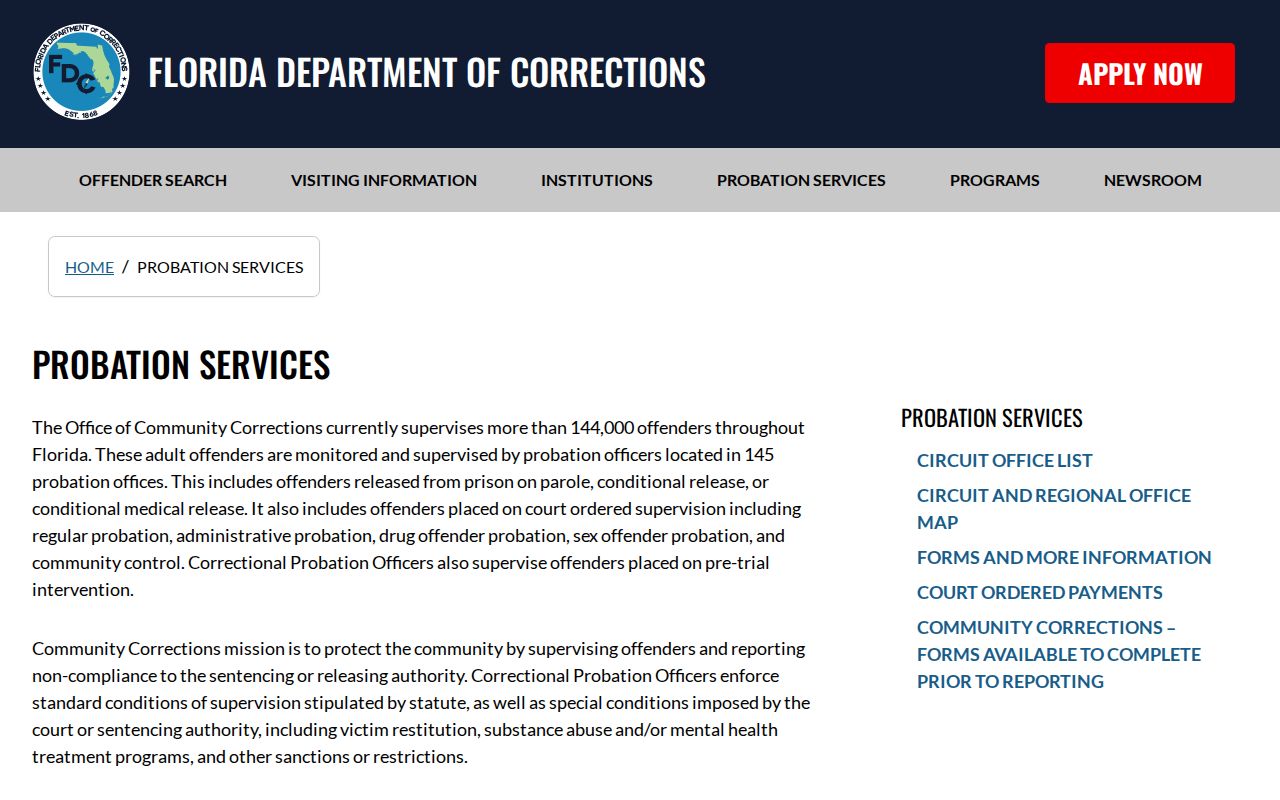
Florida parole applies mainly to eligible older sentencing structures and should not be used as a label for every supervised release.
Public Access Laws
Florida Public Records Law generally opens nonexempt agency records for inspection and copying, but court files also follow judicial access rules. The practical first step is identifying the custodian. CCSO responds for sheriff records, the Clerk for court files, and FDLE for statewide history. Agencies may charge actual copy costs and a reasonable special-service fee for extensive labor or technology. Active investigations, juvenile material, confidential victim data, sealed files, and protected identifiers may be withheld or redacted.
Key Statutes:
Chapter 119 and section 119.07 open nonexempt agency records and permit copy or extensive-use charges.
Florida Statutes section 943.053 governs FDLE dissemination and public criminal-history searches.
Florida Statutes section 943.056 provides the personal review and challenge process.
Florida court rule 2.420 sets access and confidentiality procedures for judicial records.
Citrus County Warrant Checks
FDLE's Public Access System, or PAS, provides a free statewide wanted-person search. Search by last name and narrow with first name, birth date, sex, race, or an alias when available. A result can show the warrant or offense, originating agency, photo, descriptors, and caution information. It remains a lead, not proof that the warrant is active at the moment viewed.
Confirm any Citrus County result with CCSO at 352-726-1121 or with the issuing court. A bench capias may also appear as an event in SCORSS. Sealed warrants and indictments will not appear, while a cleared entry can lag behind the court action. Resolution may require a court appearance, bond, or a motion to recall the warrant. Do not visit a public counter unannounced to address a surrender or emergency.
The FDLE PAS search provides the statewide starting point.
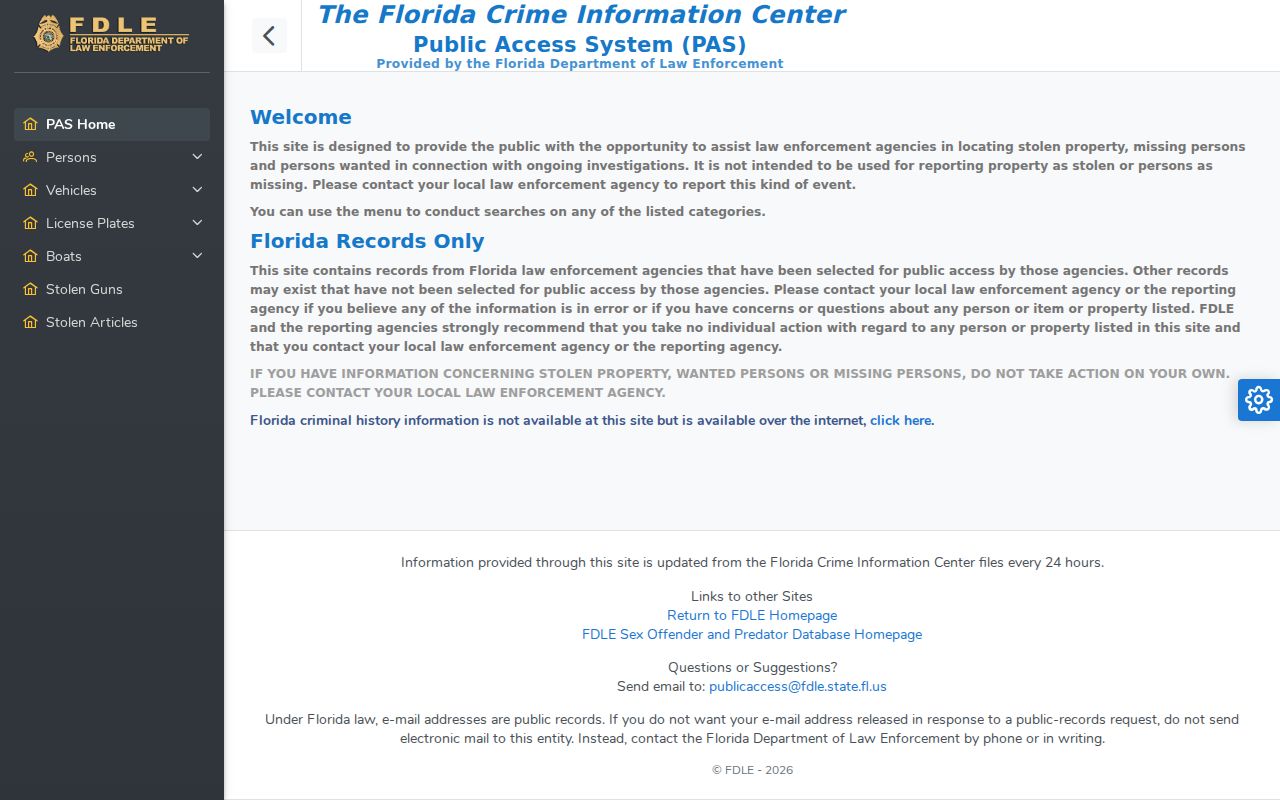
The issuing agency and court remain the authoritative sources for current warrant status.
Sealed, Expunged, and Restricted
Florida uses both court-ordered sealing and expungement. FDLE must issue a Certificate of Eligibility before a qualifying petition is filed. Sealing restricts public access while agencies retain the record under law. Expungement directs qualifying records to be destroyed or eradicated, subject to statutory exceptions. Neither remedy is automatic merely because a case was dismissed, and separate rules cover juvenile and lawful-self-defense expunction.
Start with FDLE's seal and expunge process, then use the Citrus County court file to confirm the disposition. A public portal may stop returning a record after relief, but criminal-justice agencies and other entities named by law can retain limited access. Juvenile, active investigative, victim, and sealed information may also be restricted without sharing the same legal status.
The FDLE Personal Review page explains self-review before correction or relief.
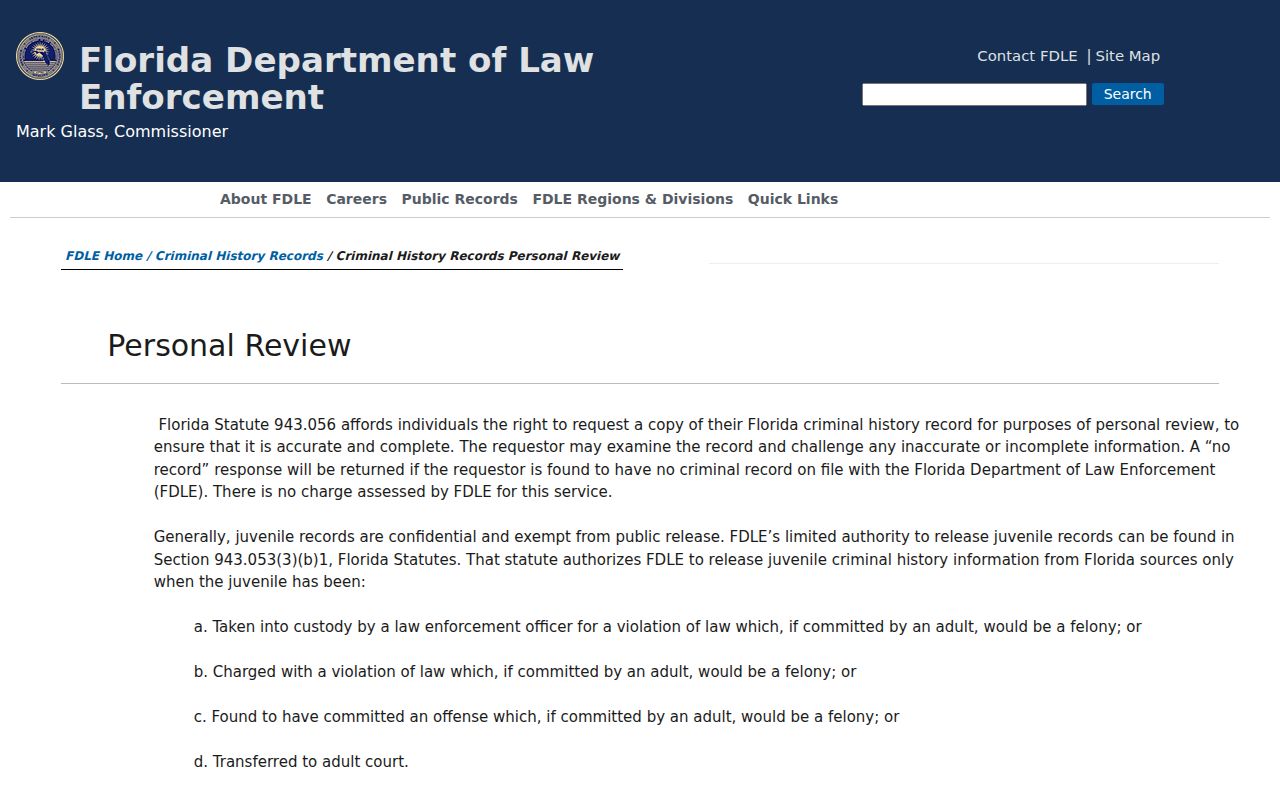
Comparing the fingerprint review with the certified Citrus County disposition can expose a missing or incorrect outcome.
Citrus County Specialty Court Records
The Fifth Judicial Circuit lists Adult Felony Drug Court and Mental Health Court among local programs. These programs use treatment and close supervision for qualifying cases, but a public name search does not prove that someone is eligible, enrolled, or successful. The ordinary Citrus County criminal docket remains the source for filed charges, orders, violations, and the ultimate disposition that may be public.
Program names matter when reading docket entries. Drug court is not a separate criminal-history repository, and Mental Health Court does not erase a case by itself. Participation terms may appear through orders or hearing entries, while clinical details can remain confidential. Teen Court and dependency programs address different systems and should not be treated as adult criminal convictions.
The FDLE national and Livescan overview also clarifies when an official fingerprint channel differs from a local court program.
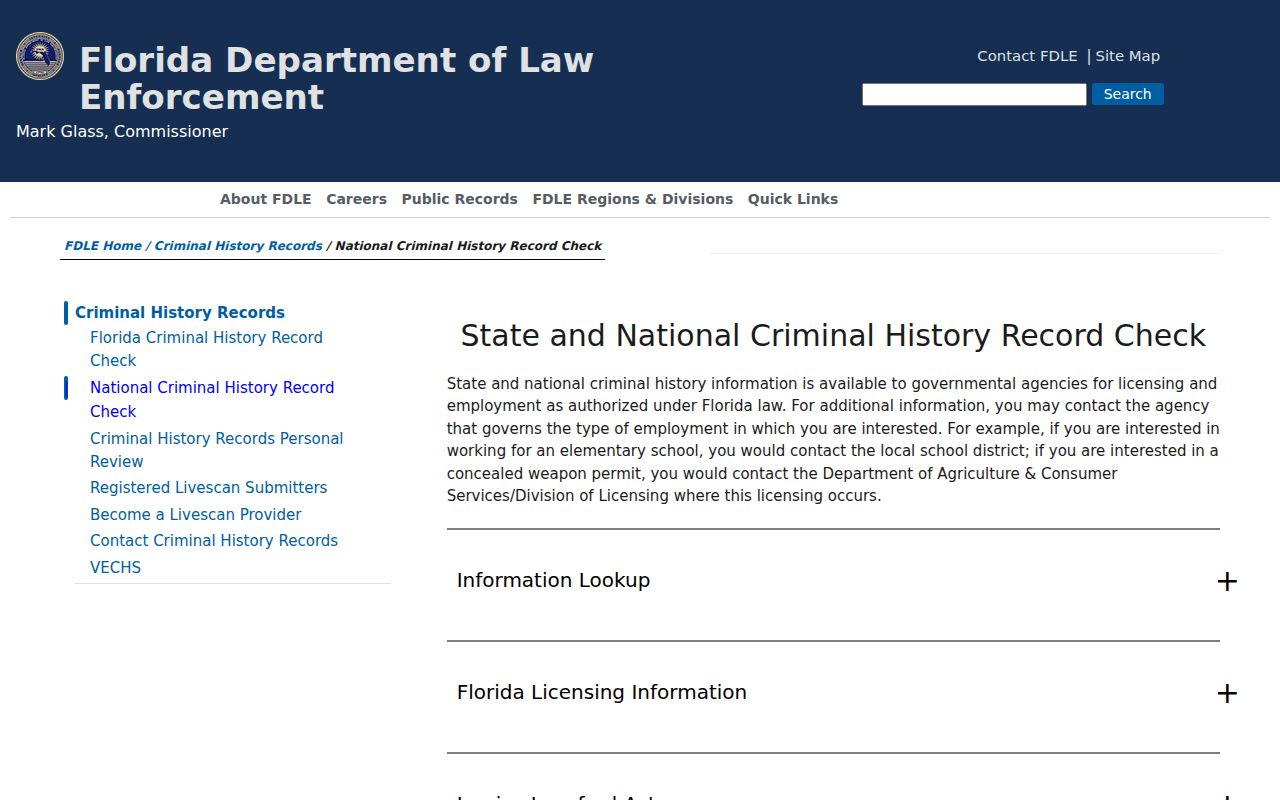
The agency directing a statutory check must supply its own ORI before a Livescan submission.
Criminal Records by City in Citrus County
Citrus County has only two incorporated cities, Inverness and Crystal River. Neither maintains an independent police department or municipal criminal court. Both contract with CCSO, so sheriff arrest and incident records from either city follow the same county route. Filed cases go to the Citrus County Clerk and SCORSS. City clerks instead hold city-created administrative records. The difference between the two city routes is location: Inverness is the county-seat hub, while Crystal River has a CCSO station at City Hall and the nearby West Citrus Clerk counter.
Inverness Criminal History
7,887 in the 2024 Census estimate · CCSO reports and the Apopka Avenue Clerk counter
Crystal River Criminal History
3,396 in the 2020 Census profile · CCSO City Hall station and Meadowcrest Clerk counter
Citrus County Records Changed Locations
Citrus County's record geography has deep roots. The county was formed in 1887, with Mannfield as its first seat. After voters chose Inverness in 1891, county records, furniture, and fixtures were moved by horse and wagon during a celebrated nighttime transfer. The historic courthouse opened in 1912, and its upstairs courtroom remained in use until a ceiling failure during a 1992 hearing.
Those landmarks explain a modern search trap. The historic courthouse at 1 Courthouse Square is not the working criminal courthouse. Current case service is at 110 N. Apopka Avenue or West Citrus Government Center. Likewise, the jail sits in Lecanto and CCSO headquarters keeps law-enforcement reports. A request can be valid yet still reach the wrong custodian or building.
Local source records still control when the statewide chronology lacks a recent disposition. That is why the Clerk's judgment and CCSO report remain important even after a state search.