
Criminal Cases in Citrus County Courts
Citrus County splits criminal work by offense level. The Circuit Court of the Fifth Judicial Circuit hears felonies. Citrus County Court handles misdemeanors, county ordinance cases, and criminal traffic. The elected Clerk keeps both sets of files at the Citrus County Courthouse in Inverness. A felony case commonly carries the code CF, while MM identifies a misdemeanor and CT points to criminal traffic. Those codes help distinguish two people with similar names and show which court owns the matter.
The Clerk Criminal Division maintains the index, docket, filed pleadings, orders, financial ledger, and disposition. Its counter is at 110 N. Apopka Avenue, Inverness, and is open weekdays from 8 a.m. to 5 p.m. Call 352-341-6424 and choose option 4 for criminal matters. The court switchboard is 352-341-6700. West Citrus Government Center at 1540 N. Meadowcrest Boulevard in Crystal River offers searches, viewing, copies, inquiries, and payments during the same weekday hours. It is a service counter, not a separate court.
Search Citrus County Cases in SCORSS
The Clerk's SCORSS access page leads to the Secure Courts Online Record Search System. Public Internet users may search without an account. The anonymous role returns public indexes and docket events but not document images, dates of birth, or complete addresses. Registered users, parties, attorneys, prosecutors, public defenders, law enforcement, and clerk kiosks receive access based on their role. An empty image pane therefore does not mean the filing does not exist.
SCORSS is the right first stop for a Citrus County criminal case search. Use the full case number when known. For a name search, begin with the surname, then add a first name, filing range, or case type. Avoid assuming that the first same-name result is the correct person. Match the filing year, agency reference, charge, and later disposition.
Search Citrus County Case Records
A careful search moves from a broad index result to the docket and then to the source document. This five-step method works for both recent Citrus County criminal court cases and older indexed matters.
- Open SCORSS and select the public Internet or anonymous role.
- Choose case-number or party-name mode, then enter the strongest known identifier.
- Narrow the result with filing dates and CF, MM, CT, or another listed case type.
- Open the docket and read each count, event, plea, adjudication, and disposition.
- Ask the Clerk for the filed image or a certified copy when the outcome must be documented.
| Field Label | Type | Required | Notes |
|---|---|---|---|
| Search mode | Tab | One mode | Choose case number or party. |
| Case Number | Text | For that mode | Include year and local case code. |
| Last or Business Name | Text | For party mode | Surname is the best first input. |
| First and Middle Name | Text | No | Use to narrow common surnames. |
| Date of Birth | Date | Restricted | Not published to anonymous users. |
| Case Type | Select | No | Includes CF and other listed codes. |
| Filing Date From/To | Date | No | Limits a large result list. |
Citrus County Case Images Offline
SCORSS deliberately gives anonymous users less than a courthouse terminal. The web view can show that a motion, information, judgment, or sentence was filed, yet withhold its scanned image. Use the docket entry as a locator. Note the case number, filing date, event description, and count, then request the exact document at either Clerk counter. This keeps the request narrow and may reduce staff search time.
The Clerk also offers a Court History Record Search form for a name-based history request. It asks for requester details, the name and prior names to search, date of birth, years covered, record type, certification choice, delivery instructions, signature, and date. Older material or a record that is hard to isolate online can be handled through that form. The Clerk's public-record request route covers other clerk-held material and explains custodian routing.
Ask whether the copy must be certified before placing the request. A certified disposition bears the Clerk's authentication and is the best court source for proving how filed counts ended. A plain screen print may be enough for personal research, but it does not replace the filed order. The research did not confirm a current Citrus fee for the history form, so obtain the amount, delivery terms, and processing estimate directly from Criminal Matters instead of relying on an old fee schedule.
What a Citrus County Case Shows
A Citrus County court file tracks what prosecutors filed and what the judge did afterward. It may include an arrest or agency reference, but it is not the sheriff's incident report. Read every count separately because one charge can be dismissed while another ends in a plea or trial judgment.
| Case Number & Court | Filing year, sequence, case code, division, judge, status, and parties. |
|---|---|
| Charging Document | Complaint, information, or indictment stating the filed counts, statute, and degree. |
| Docket Entries | Dated filings, motions, orders, warrants or capias events, and filing party. |
| Hearing Dates | Scheduled event type, date, time, and later continuances or cancellations. |
| Disposition & Judgment | Plea, dismissal, nolle prosequi, acquittal, withhold, or adjudication for each count. |
| Sentence & Conditions | Custody, jail credit, probation, fines, costs, restitution, and payment activity. |
Bond data can appear in both booking and court files. The later judicial order controls. A docket may also show a bench warrant or capias, which is a court command to take someone into custody. Verify current status with the issuing court and law enforcement before acting on an old entry.
Read Citrus County Case Codes
Three short labels prevent common mistakes. CF points to a felony file in Circuit Court. MM marks a misdemeanor in County Court. CT means criminal traffic, also handled in County Court. Criminal Miscellaneous may appear as CFM. The Clerk's published case-type list reports different online coverage dates by type, including CF felony indexes from filing year 1977. An older index hit may therefore exist even when the image does not.
- Nolle prosequi
- The State Attorney's formal decision not to continue a charge.
- Withhold of adjudication
- A plea or finding without a formal adjudication of guilt, when Florida law permits it.
- Adjudicated guilty
- A judgment of guilt entered by the court.
- Disposition
- The outcome of a count or case, not merely its current open or closed status.
Citrus County Criminal Case Stages
The booking label is only the start. After an arrest or notice, a person who remains held generally receives a first appearance within 24 hours. A judge reviews probable cause, counsel, and release. The State Attorney then screens the event and may file an information, pursue an indictment, change the counts, or decline a charge. Arraignment brings a plea to the filed charge. Discovery and motions follow, then a negotiated plea or trial. Adjudication, sentence, and possible post-judgment review complete the trial-court path.
Case flow: Charges Filed › Arraignment › Pretrial › Plea or Trial › Disposition › Sentencing
The source image below comes from the State Attorney for Florida's Fifth Judicial Circuit, the office that prosecutes Citrus County cases after screening law-enforcement referrals.

The prosecuting office's role explains why a filed information may differ from the offense description shown at booking.
Arraignment is the hearing at which the defendant hears the filed charge and enters a plea. Pretrial docket entries can show discovery, motions, continuances, and negotiated settings. A plea of nolo contendere means no contest; the court may impose sentence without an express admission. After trial, an acquittal is a not-guilty result. Post-judgment motions and an appeal can add later entries without changing which Citrus clerk holds the trial-court file.
Citrus County Criminal Case Levels
Offense degree determines the local courtroom. Capital, life, first-degree, second-degree, and third-degree felonies belong in Circuit Court. First- and second-degree misdemeanors, criminal traffic, and county ordinance cases belong in County Court. A charge label alone does not predict the sentence. Offense-specific laws and enhancements can change the range, and a docket abbreviation may describe the arrest allegation rather than the filed degree.
The Clerk's case-type coverage list is pictured below and helps a searcher choose the correct SCORSS category.
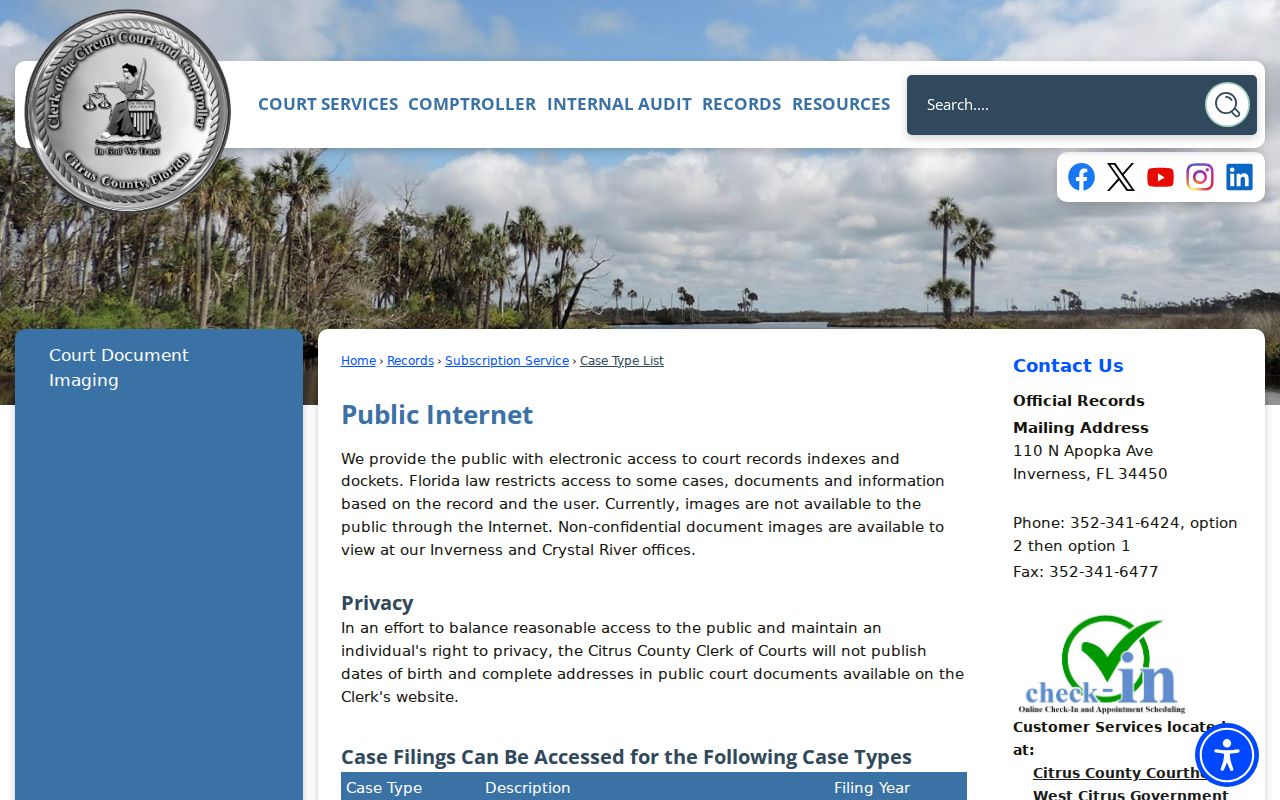
Choosing CF, MM, or CT before reading the docket reduces false matches and routes copy questions to the right criminal division file.
Citrus Arrest Charges and Filed Cases
A deputy records the legal basis asserted at arrest, but the State Attorney screens that referral before prosecution. The later information may omit a booking charge, change its degree, divide conduct into different counts, or add a supported count. A grand jury indictment can serve as the charging document in a qualifying case. Because those steps belong to different offices, do not describe a booking label as the final Citrus County criminal case.
Compare the agency or arrest reference in SCORSS with the booking record, then read the filed charging document and final disposition. The court outcome, not the intake label, answers whether a count was dismissed, declined, resolved by plea, tried, or adjudicated. When the public Internet role will not display the information or judgment image, request that exact document from the Clerk.
Citrus County Case Access & Restrictions
Florida court records begin with a presumption of access, but Rule 2.420 governs judicial records and confidentiality. Anonymous SCORSS access suppresses birth dates, full addresses, and document images. Juvenile files, sealed or expunged matters, protected victim details, active investigative information filed under seal, and other confidential material may be absent or redacted. Grand-jury proceedings are secret even though a resulting indictment can enter the public case file.
If a Citrus County criminal case does not appear, check the spelling, prior names, date range, and case code. Then ask the Clerk whether the record is older, role-restricted, confidential, or indexed under a different identifier. A public requester normally need not explain a purpose, but identification can be required for party-only access. Ask for the legal basis when information is withheld. For the event before charges were filed, use the county's official arrest history channels; for the judicial outcome, rely on the Clerk's certified disposition.